The Details Of Spacesuites
There Is More Than You Know
Introduction to Spacesuits: A Personal Spacecraft
Picture yourself floating in the endless void, protected only by a sophisticated shell that keeps you alive in one of the most hostile environments imaginable. Spacesuits function as personal spacecraft, delivering life-saving protection when astronauts venture beyond Earth’s protective atmosphere. These remarkable garments represent far more than simple clothing—they’re intricate life support systems engineered to combat the deadly realities of outer space.
Every spacesuit creates a protective bubble around the wearer that proves as vital as any spacecraft for survival. The complexity of these systems rivals that of small vehicles, incorporating multiple redundant safety features to prevent catastrophic failure. These systems:
- Maintain stable internal pressure
- Deliver breathable oxygen
- Remove dangerous carbon dioxide
- Manage bodily waste
- Regulate temperature
- Enable clear communication with mission control
Different mission requirements demand specialized spacesuit designs. Intravehicular Activity (IVA) suits prioritize comfort and safety inside pressurized cabins during critical phases like launch and reentry. Extravehicular Activity (EVA) suits offer independent mobility and maximum protection for dangerous spacewalks outside the spacecraft. Intra/Extravehicular Activity (IEVA) suits provide flexibility for both internal and external operations, bridging the gap between the other two categories.
Understanding these life-saving systems reveals why spacesuits rank among humanity’s most important technological achievements for space exploration.
The Hostile Environment of Space and Physiological Challenges

Space presents an environment so harsh that unprotected human exposure results in death within seconds. The complete absence of atmospheric pressure, combined with temperature extremes and radiation bombardment, creates conditions that no biological organism can survive without technological intervention. Each environmental factor poses unique threats that spacesuit designers must address through advanced engineering solutions.
Vacuum and Ebullism
The near-perfect vacuum of space creates immediate life-threatening conditions for the human body. Without atmospheric pressure to maintain liquid states, bodily fluids begin vaporizing in a process called ebullism. This rapid expansion causes soft tissues to swell dramatically, potentially doubling normal body size within minutes. Saliva boils on the tongue, and blood vessels near the surface expand painfully.
Oxygen starvation affects the brain almost instantly, causing unconsciousness within approximately 15 seconds of vacuum exposure. The cardiovascular system cannot function properly without adequate pressure differential, leading to circulatory collapse. Attempting to hold one’s breath during rapid decompression creates additional dangers, as expanding gases can rupture lung tissue and cause fatal air embolisms.
Modern spacesuits counter these effects by maintaining pressurized environments that closely mimic Earth’s atmospheric conditions at safe altitudes.
Extreme Temperatures
Space temperatures fluctuate wildly depending on solar exposure and orbital position. Direct sunlight can heat surfaces to scorching temperatures reaching 121°C (250°F), while shadowed areas plummet to frigid -233°C (-387°F). These extreme swings occur rapidly as spacecraft orbit Earth every 90 minutes, transitioning between blazing heat and freezing cold.
Human thermoregulation systems cannot cope with such dramatic variations without assistance. Spacesuits incorporate multiple thermal protection layers, including reflective outer shells and active cooling systems. Liquid Cooling and Ventilation Garments circulate chilled water against the astronaut’s skin, removing excess body heat during strenuous activities.
The thermal protection must work in both directions—preventing heat loss in shadow while dissipating excess thermal energy in sunlight. This dual requirement demands sophisticated engineering solutions that balance insulation with heat rejection capabilities.
Radiation Exposure
Beyond Earth’s protective magnetosphere and atmosphere, astronauts face constant bombardment from solar radiation and cosmic rays. This high-energy radiation can:
- Damage cellular DNA
- Increase cancer risks
- Cause acute radiation syndrome during solar particle events
- Create secondary radiation through atomic interactions
Spacesuit visors feature gold-tinted coatings that filter harmful ultraviolet radiation while reducing intense solar glare. The metallic layer reflects dangerous wavelengths that could damage the astronaut’s eyes and facial skin. Additional radiation shielding in suit materials provides some protection against lower-energy particles, though complete shielding against all space radiation remains technically challenging.
Long-duration missions require careful radiation dose monitoring to prevent exceeding safe exposure limits established by space agencies.
Micrometeoroids and Orbital Debris
Tiny particles traveling at hypervelocity speeds pose serious puncture threats to pressurized spacesuits. These micrometeoroids, often smaller than grains of sand, carry kinetic energy equivalent to bullets due to their extreme velocities reaching 27,000 kilometers per hour. Even paint flecks from previous missions can cause significant damage at such speeds.
Spacesuit outer layers incorporate multiple protective shells designed to absorb and distribute impact energy. The Thermal Micrometeoroid Garment features successive layers of different materials that work together to stop penetration. Impact energy spreads across wider areas, preventing concentrated damage that could breach the pressure boundary.
Orbital debris tracking helps mission planners avoid known hazardous areas, but complete protection requires robust suit construction capable of withstanding unexpected impacts.
Core Functions and Design Requirements of Spacesuits
Modern spacesuits integrate numerous critical subsystems that work together seamlessly to maintain astronaut safety and operational capability. Each component serves specific functions while contributing to overall system reliability through redundant design approaches.
Life Support Systems
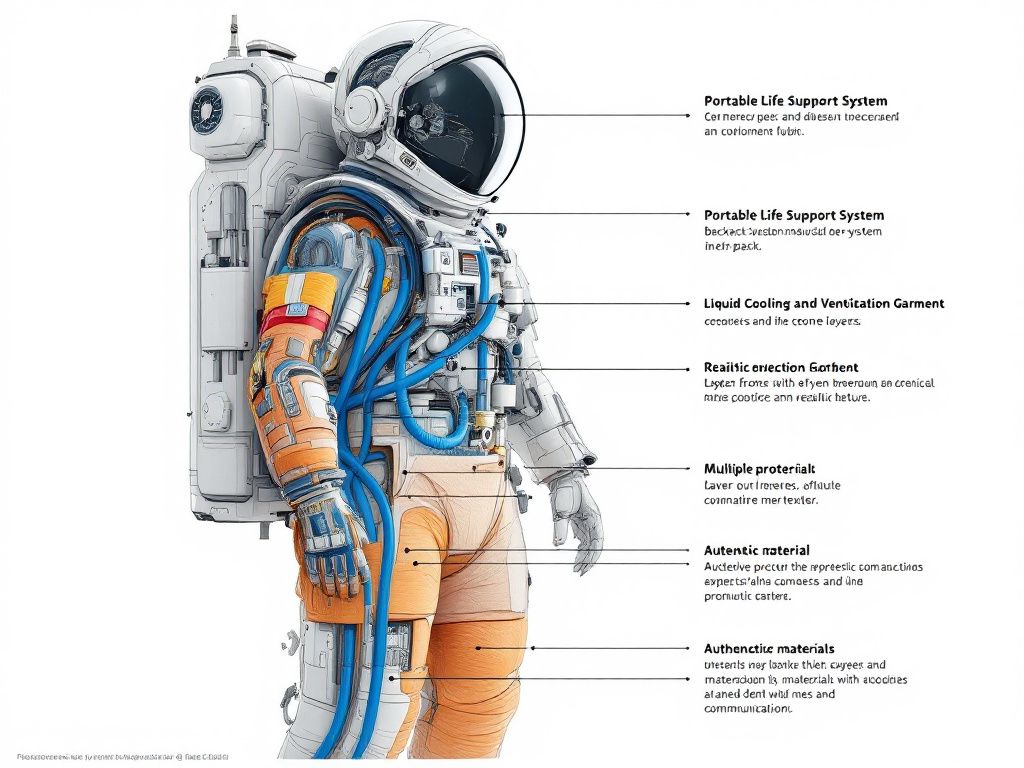
Maintaining breathable atmosphere inside a spacesuit requires sophisticated life support technology. The suit must provide steady internal pressure equivalent to safe breathing conditions, typically around 4.3 psi of pure oxygen compared to Earth’s 14.7 psi mixed-gas atmosphere. This pressure prevents ebullism while reducing the risk of decompression sickness during transitions.
Portable Life Support Systems (PLSS) function as independent life support backpacks, continuously supplying fresh oxygen while removing exhaled carbon dioxide through chemical scrubbers. These systems follow a systematic approach:
- Provide steady internal pressure (4.3 psi pure oxygen)
- Supply fresh oxygen continuously
- Remove exhaled carbon dioxide through chemical scrubbers
- Monitor gas composition and flow rates
- Circulate gases to prevent CO2 accumulation
Temperature regulation combines passive insulation with active cooling systems to manage thermal loads. Liquid Cooling and Ventilation Garments worn against the skin circulate chilled water through plastic tubing, removing metabolic heat generated during physical activity. Backup ventilation systems provide airflow for heat removal when primary cooling systems fail.
The integration of these life support functions creates redundant safety margins that protect astronauts even when individual components malfunction.
Mobility and Ergonomics
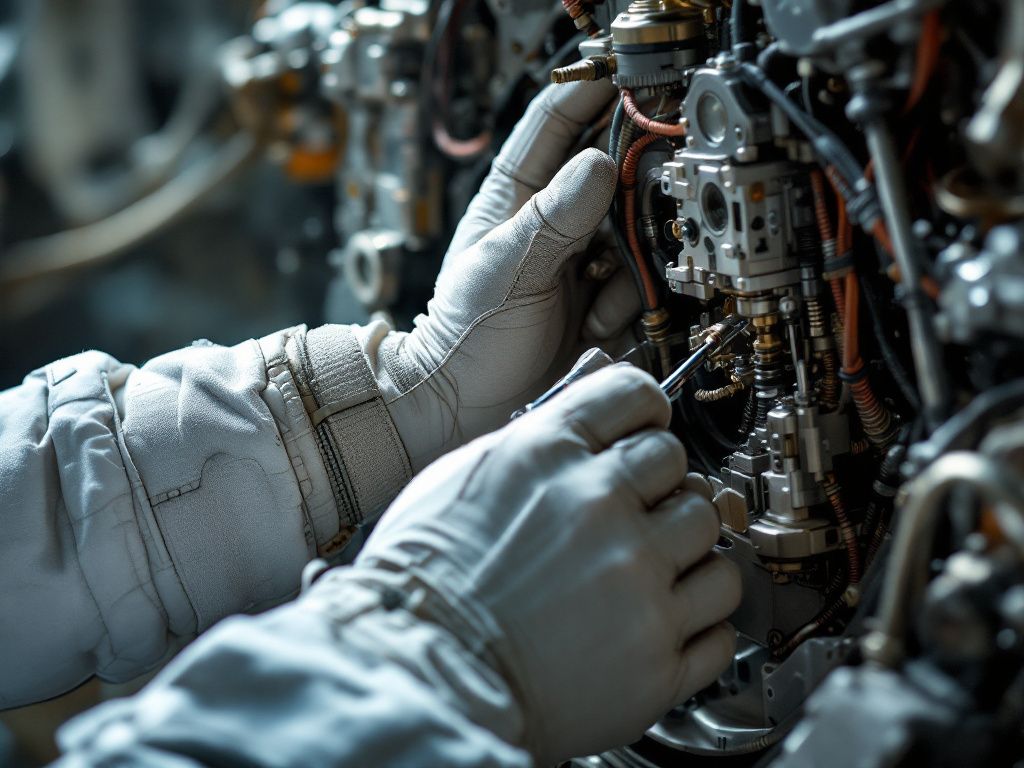
Pressurized spacesuits naturally resist bending and movement, creating significant mobility challenges for astronauts performing detailed tasks. Designers address these limitations through innovative joint construction that maintains internal pressure while allowing necessary flexion. Soft suit joints incorporate fabric bellows called convolutes that expand and contract during movement, maintaining constant internal volume.
Hard suit designs employ mechanical bearings at major joints, providing smooth rotation while preserving pressure integrity. These bearing systems require precision manufacturing and regular maintenance but offer superior durability for repeated use. Advanced designs combine both approaches, using hard elements at primary joints with flexible connections for fine motor control.
Glove design represents particular challenges, as astronauts must manipulate tools and controls while maintaining dexterity despite thick pressurized barriers. Modern spacesuit gloves feature articulated fingers with multiple joints, allowing complex hand movements necessary for EVA tasks. Tactile feedback systems help astronauts feel objects through their protective barriers.
Ergonomic considerations extend beyond basic movement to include reach envelopes, visual fields, and tool accessibility that determine operational effectiveness during critical mission phases.
Communication and Waste Management
Clear communication capabilities enable coordination between crew members and mission control during complex spacewalk operations. Spacesuits incorporate multiple communication systems including voice loops, data transmission, and emergency backup channels. The iconic “Snoopy cap” contains microphones positioned near the astronaut’s mouth along with speakers for receiving transmissions.
Digital communication systems transmit telemetry data about suit performance, life support status, and astronaut physiological parameters to ground controllers. This real-time monitoring allows immediate response to developing problems before they become life-threatening emergencies. Backup communication methods provide redundancy when primary systems fail.
Waste management systems address biological necessities during extended EVA operations lasting up to eight hours. Maximum Absorbency Garments (MAGs) collect and contain liquid waste, while specialized collection systems manage solid waste when necessary. These systems must function reliably in zero gravity while preventing contamination of suit life support systems.
Hydration systems provide drinking water through bite valves connected to internal water bags, maintaining astronaut comfort during long operations. Food consumption during EVA remains limited due to the sealed helmet environment.
Protection and Durability
Spacesuit outer layers provide multiple protective functions against environmental hazards encountered during space operations. The Thermal Micrometeoroid Garment (TMG) serves as the outermost barrier, constructed from advanced materials including Kevlar, Nomex, and specialized polymer films. Each layer serves specific protective functions while contributing to overall system durability.
| Suit Type | Primary Use | Key Features | Duration |
|---|---|---|---|
| IVA Suits | Inside spacecraft during critical phases | Comfort, safety, emergency protection | Extended wear periods |
| EVA Suits | Spacewalks and surface operations | Independent life support, maximum protection | Up to 8 hours |
| IEVA Suits | Both internal and external operations | Versatility, enhanced protection | Variable |
Thermal protection manages extreme temperature variations through reflective outer surfaces and insulating inner layers. Aluminized Mylar reflects solar radiation while maintaining flexibility for astronaut movement. Multiple insulation layers trap air spaces that prevent heat transfer between hot and cold surfaces.
Micrometeoroid protection relies on spaced armor concepts where successive layers absorb impact energy from high-velocity particles. The outer layer breaks up incoming projectiles while inner layers catch fragments and distribute remaining energy. This approach provides effective protection against most space debris while maintaining acceptable weight and flexibility.
Chemical resistance protects against contamination from spacecraft outgassing, fuel vapors, and other potentially hazardous substances encountered during space operations. Material selection emphasizes compatibility with space environments while avoiding degradation from radiation exposure and temperature cycling.
Evolution of Spacesuit Design and Technology
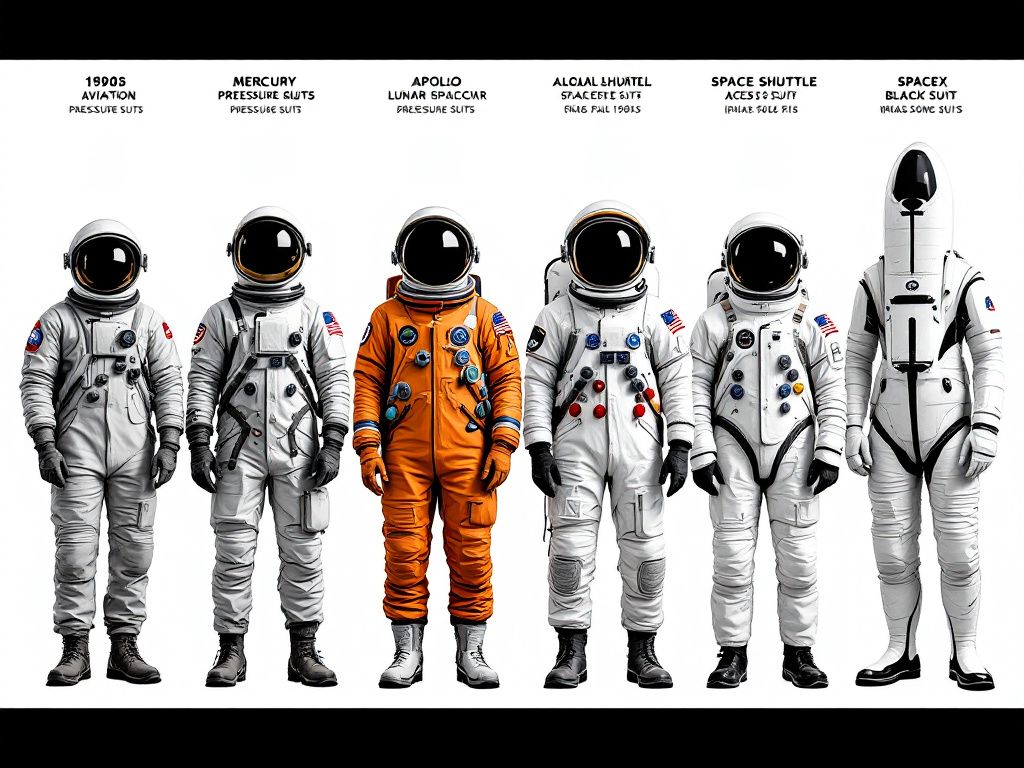
The development of spacesuits reflects humanity’s growing understanding of space environment challenges combined with advancing materials science and engineering capabilities. Each generation of suits incorporated lessons learned from previous missions while pushing technological boundaries to enable more ambitious exploration goals.
Early Pressure Suits and the Space Race
High-altitude flight pioneers of the 1930s and 1940s created the foundation for modern spacesuit technology through experimental pressure garments. Aviators like Wiley Post developed full-pressure suits enabling flights above 50,000 feet, establishing basic principles still used today. Soviet engineer Evgeniy Chertovsky and Spanish engineer Emilio Herrera contributed crucial early designs that influenced later space applications.
The Mercury program utilized modified Navy Mark IV pressure suits primarily as emergency backup systems for cabin depressurization events. These early IVA suits provided basic life support but limited mobility, reflecting the constraints of 1960s technology and mission requirements. Soviet Vostok cosmonauts wore similar SK-1 suits that prioritized simplicity and reliability over advanced features.
Project Gemini introduced the first true EVA capability with G4C suits designed for spacewalk operations. These early IEVA suits connected to spacecraft life support through umbilical cords, providing oxygen and cooling while removing exhaled gases. Early spacewalks revealed significant challenges with thermal management and mobility that drove improvements in subsequent designs.
The intense competition of the Space Race accelerated spacesuit development as both American and Soviet programs pushed the boundaries of what was technically possible with available materials and manufacturing methods.
Apollo and the Lunar Mission Era
Moon landing requirements demanded revolutionary advances in spacesuit independence and mobility. The Apollo A7L spacesuit featured the first truly autonomous Portable Life Support System, enabling astronauts to work independently on the lunar surface for hours at a time. This backpack system provided oxygen, removed carbon dioxide, and circulated cooling water without connection to the spacecraft.
“A spacesuit is really a small spacecraft. It has to do everything a spacecraft does – life support, protection, mobility, communications – but it has to do it while wrapped around a human being.” – Chris Hadfield, astronaut
Lunar surface operations required enhanced mobility for walking, climbing, and equipment handling in one-sixth Earth gravity. The A7L design incorporated improved joint flexibility while maintaining pressure integrity necessary for vacuum operations. Multiple protective layers included fire-resistant Beta cloth outer shells, learned from the tragic Apollo 1 fire that killed three astronauts during ground testing.
Thermal management systems proved critical for lunar operations where surface temperatures varied dramatically between sunlit and shadowed areas. The Liquid Cooling and Ventilation Garment became standard equipment, circulating chilled water against the astronaut’s skin to remove metabolic heat generated during strenuous surface activities.
The iconic Apollo spacesuits enabled twelve astronauts to walk on the Moon across six successful landing missions, establishing design principles that influence modern suit development decades later.
Space Shuttle and ISS Era
Shuttle program requirements emphasized reusability and operational efficiency for routine space access missions. The Advanced Crew Escape Suit (ACES) provided emergency protection during launch and landing phases while prioritizing comfort for routine operations. Its distinctive orange color improved visibility for search and rescue operations if emergency ejection became necessary.
The Extravehicular Mobility Unit (EMU) represented a significant advancement in EVA suit design, featuring modular construction that enabled sizing adjustments for different astronauts. This approach reduced program costs by allowing suit components to be reused across multiple missions with different crew assignments. The EMU design supported hundreds of spacewalks during Shuttle operations and continues serving ISS operations today.
Russian Orlan suits provided an alternative EVA solution featuring rear-entry design that simplified donning and doffing procedures. The semi-rigid construction offered excellent protection while maintaining acceptable mobility for most spacewalk tasks. Orlan suits equipped cosmonauts for thousands of hours of EVA operations on Soviet space stations and continue supporting ISS crew members.
This era established spacesuit operations as routine parts of human spaceflight, with hundreds of astronauts and cosmonauts performing EVA operations using these proven designs.
Emerging and Future Technologies
Modern commercial space companies bring fresh approaches to spacesuit design, emphasizing style, comfort, and advanced technology integration. SpaceX developed custom-fitted IVA suits for Crew Dragon operations that prioritize aesthetics alongside functional requirements. These suits incorporate touchscreen-compatible gloves and improved helmet designs while maintaining necessary safety margins.
The SpaceX EVA suit developed for Polaris Dawn missions features heads-up display technology and enhanced mobility for commercial spacewalk operations. This represents the first privately developed EVA suit to be tested in space operations, potentially opening new markets for commercial spacesuit development.
“We’re not just making spacesuits prettier; we’re making them more functional, more reliable, and ultimately safer for the people who wear them.” – Kathryn Sullivan, former NASA astronaut and administrator
NASA’s next-generation spacesuit programs include the Axiom Extravehicular Mobility Unit (AxEMU) designed for Artemis lunar missions and future ISS operations. This advanced design emphasizes improved mobility, broader sizing ranges, and enhanced protection systems for extended lunar surface operations. Luxury fashion brand Prada contributed design expertise to the AxEMU development, bringing high-end fashion industry experience to space applications.
Collins Aerospace developed competing next-generation suit designs under separate NASA contracts, creating competitive pressure that drives innovation and cost reduction. Theoretical concepts like suitports could revolutionize EVA operations by allowing astronauts to enter suits directly from habitat modules without traditional airlocks.
What innovations might future spacesuit generations bring as human space exploration extends to Mars and beyond?
Conclusion
Spacesuits have transformed from basic pressure garments into sophisticated personal spacecraft that make human space exploration possible. These remarkable systems integrate life support, mobility, communication, and protection functions through advanced engineering that pushes the boundaries of materials science and human factors design. Continuous innovation driven by both government agencies and commercial companies accelerates technological advancement while reducing the cost of spacesuit development for future missions.
Modern spacesuit development reflects growing confidence in human spaceflight capabilities as missions extend further from Earth. Next-generation designs promise enhanced protection, improved mobility, and operational efficiency that will enable astronauts to work safely in increasingly challenging extraterrestrial environments. The collaboration between traditional aerospace contractors and commercial space companies creates competitive pressures that drive rapid innovation.
Future space exploration missions to the Moon, Mars, and beyond will depend on continued spacesuit advancement to protect human crews during extended operations far from Earth. These personal spacecraft represent humanity’s commitment to exploring the cosmos safely and effectively, ensuring that space remains accessible for scientific discovery and commercial development.
FAQs
What Is the Primary Purpose of a Spacesuit?
Spacesuits protect astronauts from lethal space conditions including vacuum, extreme temperatures, radiation, and high-velocity debris impacts. They provide life support functions like oxygen delivery, pressure regulation, carbon dioxide removal, and temperature control that maintain human physiological needs. Without spacesuits, astronauts would lose consciousness within 15 seconds and die within minutes of space exposure. These personal spacecraft enable humans to work safely in environments that would otherwise be instantly fatal.
How Much Does a Spacesuit Cost?
NASA spacesuits represent enormous investments in research, development, and manufacturing. Apollo-era A7L suits reportedly cost equivalent to $150 million in today’s currency when development expenses are included. Modern EMU suits used for Space Shuttle and ISS operations cost approximately $500 million per unit including development costs. NASA’s next-generation spacesuit contracts with Axiom Space and Collins Aerospace total several billion dollars for development and operational services. These costs reflect the extensive testing, quality control, and safety requirements necessary for human-rated space systems.
What Are the Different Types of Spacesuits?
Three main spacesuit categories serve different mission requirements:
- IVA Suits: Emergency protection inside spacecraft during launch, reentry, and docking
- EVA Suits: Independent spacewalks and planetary operations with maximum protection
- IEVA Suits: Versatile design for both internal and external operations
Each type incorporates specific design features optimized for intended operational environments and mission duration requirements. Astronaut spacesuits must balance protection, mobility, and life support capabilities based on their intended mission profiles.